
Hi, and welcome back to my blog, where I ponder my life as a photographer, writer, podcast host, educator, partner, and parent. I hope that this blog finds you all well and safe. I emphasise the ‘safe’ bit, as there’s a lot of crazy stuff going on in the world right now. There’s so much turmoil, conflict, hate, and societal collapse that it almost feels like a fever dream to turn on the news or scroll social media. What new horror will unfold today? And yet we are still expected to Keep Calm And Carry On…oh, and pay taxes, of course. Self-care is really important at troubling times like these. So please, if you are struggling to make sense of the world, take some time out. Talk to a friend or loved one. Turn off social media. Watch a nature documentary instead of the news. Go for a walk or just stop and take ten deep breaths. Anyway…enough about the doom and gloom. On to brighter and better things…like kittens!

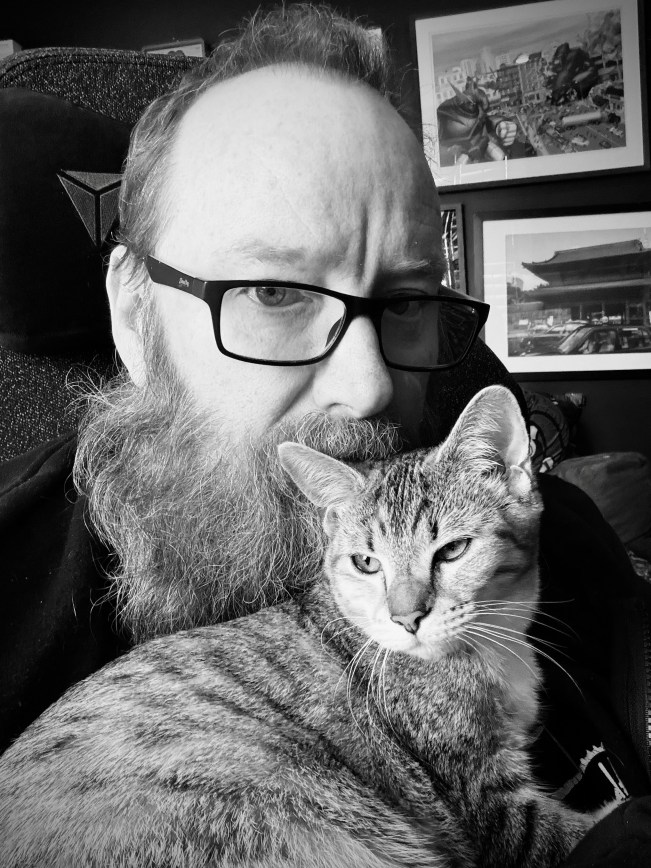
We’ve had family pets for as long as I can remember. From the dogs my parents adopted as we grew up to the cats and dog Isobel and I raised when we formed our own family. And now, of course, The Doctor and I share our home with our fur-babies. Up until a few months ago, we had five cats living with us… Oh, and let’s not forget Hazel, our Pom x Chihuahua head of security. Of those five cats, three recently moved out to live with my two adult kids when they themselves left the family home. So we were down to two cats and one dog. Not nearly enough pets for our liking. The Doctor and I decided to adopt not one, but two kittens from the Lost Dogs Home in North Melbourne. They had an overwhelming influx of new kittens and hosted hundreds of expectant families looking to elevate their home life. We did our bit and adopted Chihiro (formerly Ruby) and Susu (formerly Boots). So now we are a family of four cats: Dolcie, Haru, Chihiro, and Susu. Chihiro and Susu were quite young when we adopted them, and given that I always work from home and the Doc works from home one to two days a week, we have cherished the experience of raising a pair of kittens. Over the years, I have raised (or co-raised) at least ten cats. But they were always one at a time, with years between each adoption day. However, I have to tell you, raising two kittens together is an exercise in pure delight and whimsy.
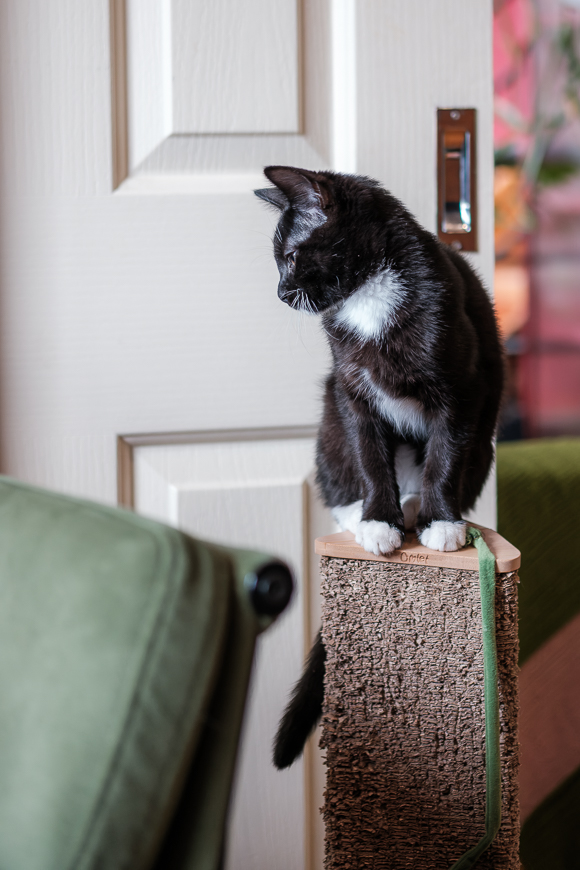
Over the years, I have always enjoyed photographing the family pets and recall photographing our family dog, Molly, when I was in art school studying film photography. And while I would never consider myself a pet photographer, I have come to love the genre as a way to document how these comparatively tiny creatures live and coexist with us. And let’s face it, kittens and puppies, and later, cats and dogs, are adorable and incredibly photogenic. Since elevating my own photography, I have taken hundreds, if not thousands, of images of our family furry friends. It’s something that I love to do, but there’s also a lot to learn from photographing the family pets. In fact, I would go so far as to say that pet photography, even if you only dabble a little, will make you a much better photographer. When other photographers ask for my advice on how to better master their camera, I always tell them never to let their camera leave their side. Whether you’re on your everyday commute to and from work or sitting at home watching television at night, keep your camera close at hand. Having your camera with you is the first step. The second step is to constantly assess the light, scene and subjects, and adjust your camera settings in real time, almost like a fidget toy. The final step is to take photos of everything around you, regardless of the lighting or subject matter. I believe that constant, idle interaction with your camera will help you cement your muscle memory for quickly controlling it. It will teach you how to read the light, quickly dial in the settings, and understand the results you get under varying light conditions. I further believe that, in the exact same way, pet photography will teach you much about your craft. Let’s unpack that!

Pet Photography Begins With The Light

Regardless of how adorable or photogenic your pets are, images will always look better when shot in good light. And, as I teach my street photography workshop clients, photography begins and ends with light. Before we consider composition or even subjects, we have to know where the good light is. When at home, you will notice how light filters in through windows and doors. Regardless of the season or weather, light will travel throughout your home with the arc of the sun. Light will appear in different places at different times of the day. And of course, where there is light there is shadow, and those shadows will make their own journey throughout the day. As photographers, I highly encourage you to make it a habit to familiarise yourself with how light travels through your home. Not only does it help you to develop a ‘photographer’s eye for light’, but it will also help you identify the best places and times to use that light for your image-making. The more you do this, the better you will master the art of reading the light and shadow in any setting. And of course, in the evenings, you will use the same skills to determine how your interior lighting affects or elevates a scene.
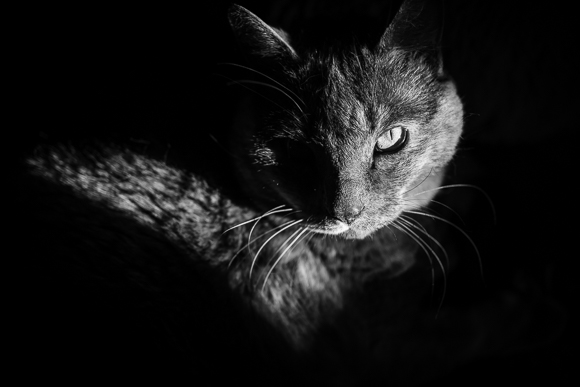
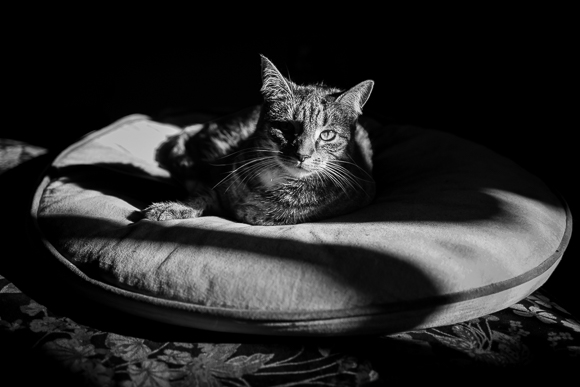
With a keen eye for how light moves around your home, consider how your pets respond to it. Dogs and cats love sunbathing both inside and out. Cats are especially drawn to light and warmth to regulate their body temperature and soothe their muscles and joints. So if you find a great pocket of sunlight streaming in through your window, there’s a good chance that your pet will wander into that light at some point. And, if you’re lucky, they will rest, sleep, and frolic in that pool of light. Having your camera close at hand at all times amplifies your opportunities to see these interactions with the light and take your shots. It’s almost cheating! After all, the pets will be the ones to find the light and show you where they intend to pose for their photoshoot. Another benefit of photographing your pets in great light is the interplay between shadows and highlights. A cat sitting half in and half out of the light makes for a compelling composition. Plus, it allows you the opportunity to observe the light, dial in your exposure triangle, and work on composition.
Timing Is Everything

It’s often said that photography is all about capturing key, decisive moments in life. For wedding photographers, it could be the first kiss or the heartbreaking speech Uncle Steve gave at the reception. For landscape photographers, the decisive moment may be the instant the sun’s golden rays break free of the skudding clouds to illuminate the land. As photographers, we work with time and light to freeze the briefest of instances on our journey around the sun. Timing and the control of time’s flow are just as important in pet photography. And while dogs (mostly) can be asked to sit, drop, or stay, it’s fair to say that cats don’t work to the same expectations. Cats are their own boss, and photographing a cat is an exercise in patience and repetition. Hence why having your camera with you at all times is critical to this approach. Having your camera with you, or very close at hand, gives you more opportunities to pre-see these moments in time and be prepared to take the decisive shot. If you’re home from work and the pets are excited to spend time with you in the lounge or on the couch, have your camera nearby. See and read the lighting, dial in your settings, and be ready to capture those moments.

The other aspect of pet photography and mastering timing is how to control your shutter speed. Setting aside ISO and Aperture, your shutter speed determines how long the camera’s image sensor is exposed to incoming light. With pet photography, a slower shutter speed (1/30 or 1/60) will increase exposure by keeping the image sensor exposed for longer. However, the flip side is that if your pets are on the move, you are more likely to introduce motion blur. But it’s an important lesson to learn, and sometimes a blurry pet photo tells a better story than a tack-sharp portrait. Motion and blur in pet photography can help to showcase how your pet is behaving. A dog running at top speed or a cat in mid-air acrobatics can look incredible with a hint of movement in the final image. However, it’s not always the look you desire. Should you want a cleaner, sharper image of your pet, you’ll need to increase the shutter speed to freeze time and motion. Depending on your pet’s craziness when they get the zoomies, a faster shutter speed (1/125-1/500+) will freeze motion. But once again, this will affect your exposure. A faster shutter speed grants less time for light to hit the camera’s image sensor. You will get sharp images, but it may come at the cost of exposure. Compensate for faster shutter speeds with a wider aperture and/or a higher ISO. And compensate for slower shutter speeds by using a narrower aperture and lower ISO. Practice, practice, practise this skill set, as light and time are what this gig is all about.

Studying Behaviour
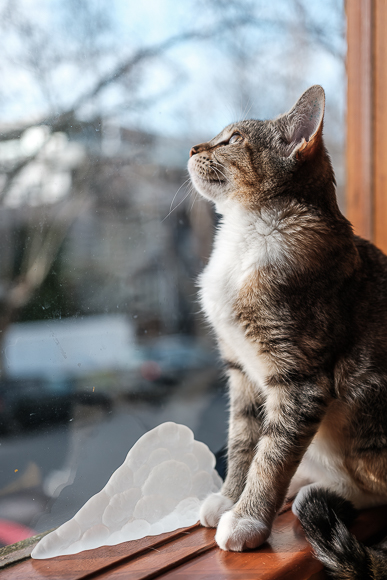
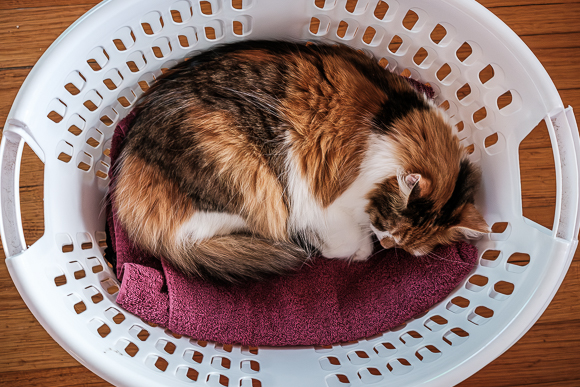
One thing I have noticed with our furry friends is their routines and schedules. The more I observe them, the more I become aware of their patterns of behaviour. This applies to all the pets in the house. Being so young, Chihiro and Susu have a fascinating daily schedule. They sleep in our bed and get up with me at around 6am every day. They use the litter tray before heading downstairs with me to start the day. They eat, return to the tray to poop, play-fight, have a nap, wake up and explore the house together; they cuddle with The Doctor and me, and then they fall asleep together on the couch once again. They can sleep for hours in the one place (a perfect time to photograph them) before they wake and repeat the cycle. In fact, at this age (approximately 5 months), kittens can sleep for up to 20 hours a day. In the afternoon, they play and frolic in the sun that streams through our loungeroom windows, bathing the room in warmth and golden light. All the animals in the house appear at this time as it is close to dinner time for all. And that golden warmth is almost impossible for them to resist. Through observing these patterns of behaviour, I have also developed an awareness of the best times to photograph them.

Developing skills in behavioural observation is yet another beneficial photography skill. The practice you put in observing your pets to understand the best moments to take the shot will serve you well in countless image-making genres. Observing how folks interact with the world around them is a core principle in my street photography pursuits. It’s part of the reason I picked up a camera not long after Isobel died in 2013. I used my camera and street photography to document and understand how life and love go on in a world without my love and best friend. Understanding your subjects’ behaviour, patterns, quirks, and attitudes can help you tell a more meaningful story in your images. It also allows you to anticipate or predict how a subject is about to behave. With cats, it’s the wiggle of the bottom before the pounce. Or the long exaggerated stretch after first waking up. For dogs, it can be the zoomies that follow a side-eye-ears-back glance (if you know, you know), or the playful leaps at being let off leash at the park. In people-focused genres, behavioural observations can help you identify how a subject moves, sits, or holds their hands. In wildlife photography, observations can yield valuable insights into when a bird is about to take flight or how a lion comes to rest among tall grass. But the most important element to behavioural observation is being ready to take the shot. Understand and identify the cues; then lift your camera before the decisive moment.
Compositional Elements
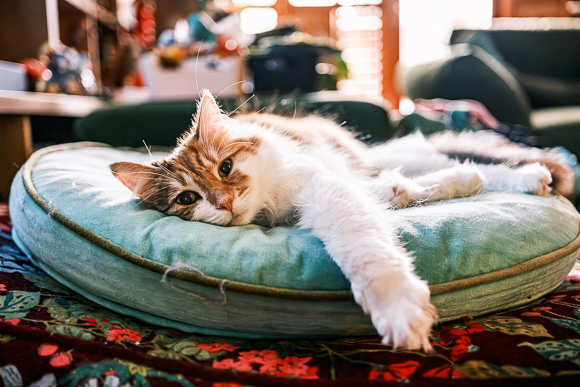
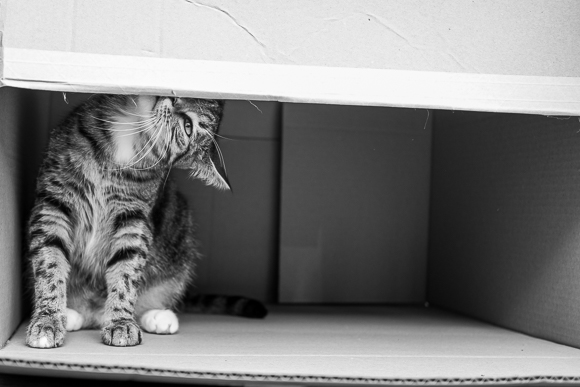
While I often prefer to photograph my pets in good light, I also photograph them in dull, flat, crappy light. They just don’t pop like those captured in a golden shaft of light. Regardless, we often don’t have great light at our disposal. The trick is to make what you have in front of you work. One of the key elements in making your pet images work is considering composition. Composition is the term we use to describe all the elements in an image that contribute to the end result. In my street photography, aside from the light, the compositional elements I look for are strong leading lines, typography, use of colour, geometry, reflections, texture, foreground and background elements, and how people enter the scene. Composition also relates to how you view and frame a scene. Rather than always taking photos at eye level, add interest and dynamics by holding your camera low to the ground or high up, or by testing a range of viewing angles to experiment with your composition skills. Zoom with your camera, or zoom with your feet, to assess the whole space or to look for interesting details others may miss. With cats and dogs being their own masters, it’s not always possible to get a clean composition. Sometimes they do the most amazing things in the most ordinary of places. Consider getting in super close to avoid a messy background. Or shoot with a narrow aperture to keep your subject in sharp focus while the background and/or foreground melt into a soft, out-of-focus blur.

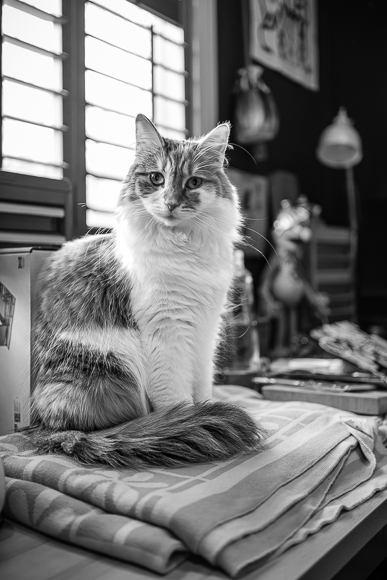
Another element I include in most of my street work is the image’s hero. The hero is typically someone who stands out in the composition for one reason or another. The hero helps tell the story while also anchoring the scene and its compositional elements. The composition adds context to the hero, and in return the hero adds character to the composition. It’s no different in pet photography. Obviously, in pet photography, the hero is your pet. Even if you have several pets and they all wander into a scene, you can still choose to make only one the hero. The hero may be in sharp focus while the others are softly blurred in the background. When considering composition, you won’t always have control over which elements are present when you go to photograph your furry resident. But through practice, experience, or trial and error, elevating your photographer’s eye to see compositions will become a natural part of your creative process. What’s more, you will become faster and faster at spotting such elements and building an impressive scene. Plus, the more you practice getting a composition right in-camera, the less time you will spend editing and the more you will enjoy the process.

What Gear Is Required For Your Pet Photography
While I have already discussed different camera settings, especially for managing the exposure triangle, I don’t want to assume or insist that everyone has a DSLR or mirrorless digital camera at their disposal. While better-quality cameras are better at handling dynamic range (low-light and highlight outcomes), and the lens choices allow for some amazing images, it really doesn’t matter what camera you have. You can photograph your pets with your $20,000+ Leica M11 and Summilux 50mm F1.4 lens combo, or with your five-year-old smartphone. Any camera can be used not only to document your pets, but also to practice many of the skills described in this article. I capture more than half of my pet images on my iPhone – currently using the impressive iPhone 17 Pro. Given that my iPhone is with me ALWAYS, it’s either always in my hand or always in my pocket. Even with my iPhone’s ultra-availability, I still keep my digital camera with me most of the time. My current set-up is the Fujifilm X-E5, usually with the sharp and fast Fujinon XF 23mm F1.4 or the XF 27mm F2.8 pancake prime. The point is that when the light is right, and Hazel, Haru, or Susu dial up the cuteness factor, I have a camera ready to go at any moment. And that is all you sometimes have! One moment, or a few seconds, is all we often have to capture that decisive moment. Be it on the streets of Melbourne, the flanks of Mount Hotham, or watching the pets at play in the lounge, sometimes you only get one shot at it.
It’s important not to overthink the gear choice for pet photography – or any photography genre you are attempting. You will notice that, despite having a speedlight and an LED lighting kit available at home, I don’t use artificial light for this genre. For one, it’s another technical barrier to quickly dialling in your settings and capturing those precious moments. Besides, flash photography may spook some animals or make them leave the room in search of peace and quiet. Of course, professional pet photographers introduce an impressive amount of kit to capture stunning pet portraits for paying fur-parents. My fellow host of The Camera Life Podcast, Justin Castles, has just begun his journey as a pro pet photographer. He intends to build a pet photography business and, as a result, has invested in lighting, light modifiers, triggers, seamless backdrops and supports, and purpose-fit lenses. The results speak for themselves. And while that is something anyone can aspire to, it all begins with mastering the basics. Basics that you can explore and discover with your fur-family without the need to invest in pro-grade gear.

The Cat’s Meow!

As a proud pet parent sharing my home with several furry friends, it’s a no-brainer to further explore and elevate my skill set through a practice like this. Not only is it a lot of fun, but it also involves the challenge of photographing a moving subject across a range of settings and lighting conditions. And while the point is to document your pets and create a lasting set of images to remember the time and space you shared, there’s a lot to learn from the experience. What’s more, you can control and optimise this learning opportunity at your own pace, without the need to invest in expensive workshops or gear. That can come later if you take a liking to this genre and want to step up to the next level. But for those new to photography, or those wishing to build their skill set, photographing your pets is an excellent way to develop an understanding of exposure, timing, behavioural observation, composition, and image curation for storytelling. You can work on all of this in the comfort of your own home while wistfully wishing you had a cat’s life. Be safe. Meow. G


Leave a Reply