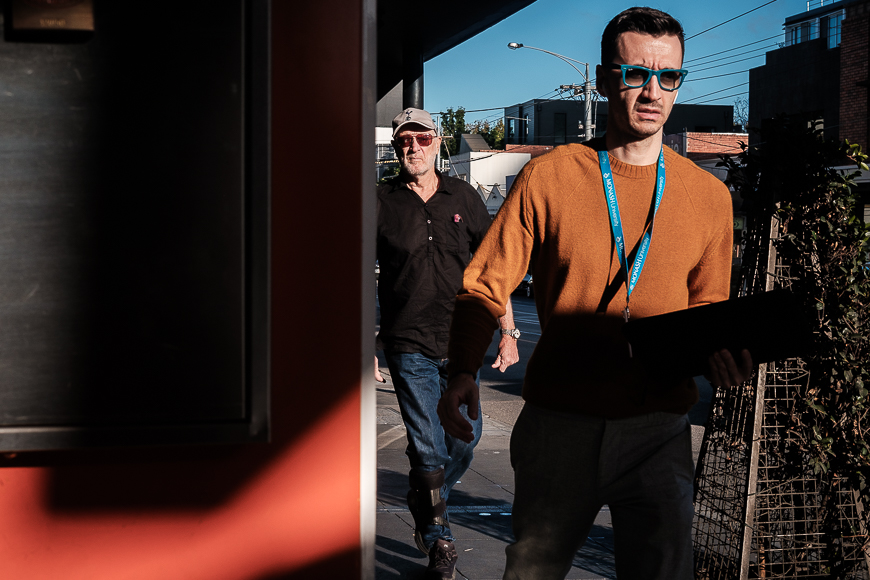
Hi and welcome back to my blog series where I discuss my journey in rediscovering my love of photography. If you’ve been reading along at home, you’ll have already seen my recent blog entries Rediscovering The Light – The Gear, and Rediscovering The Light – The Community. In those two articles, I discuss how I’ve fallen back into photography after a two year break due to poor health. Getting out and about with my camera has proven to be incredibly beneficial. I’m gradually improving my stamina, fitness, and awareness of my neighbourhood. A lot has change both within and outside of my immediate community over the past two years. Further to this, it’s wonderful to see familiar places and faces while on my photo walks.

I’ve talked about the gear I use – all Fujifilm of course! And I’ve also discussed how important being a part of a community is to my wellbeing and creative life. In this new blog entry, I want to discuss more elements of my photography process and methodology. In particular, I’ wi’ll be outlining my process for getting out and about with the camera – always in hand. I’ll talk about the times of day I hit the streets and also the paths I follow to hunt and capture the light. After all, photography is all about capturing unique moments in time where the light is just right.

Seeking Light
I’ve hear some photographers claim that unless the sun is shining there’s no point even getting your camera out of the bag. I don’t agree at all! Whilst, an important element of photography is good light, it’s not essential to have the sun shining and the sky blue. On my first trip to Kyoto, it was cloudy and rained for the entire week I was there. Except for the final day where it was blue skies and perfect Ghibli clouds. I didn’t see the sun for six days – but that wasn’t going to stop me from taking thousands of shots. There’s just as much to achieve on overcast days as there is on perfect golden days. What’s more, my Fujifilm cameras have excellent low light performance thanks to complete manual control over aperture, shutter speed, and ISO. For me, it comes down to making the most of what’s presented to me.

Currently it’s the start of Autumn here in Australia – however we’ a’re still getting hot, bright, and sunny days like it’s still summer. As a result, when I go out for a street walk, we currently have some gorgeous days to work with. Even on the hot 30 plus degree days, I try to get out at some point to walk and take photos. During the hottest part of the day, I tend to remain indoors and write or edit photos. I go out for street walks either first thing in the morning, or towards the end of the days light. It all depends on what I have going on – chores, family responsibility, taking my son to school, etc. As I tend to be out and about during the morning and afternoon golden hour, I’ve been able to make the most of the glorious light. What’s more, those times of day have the most dramatic shadows that contrast against the light falling on people and their surrounds. During this kind of weather, it’s this light that I seek.
Internal Compass
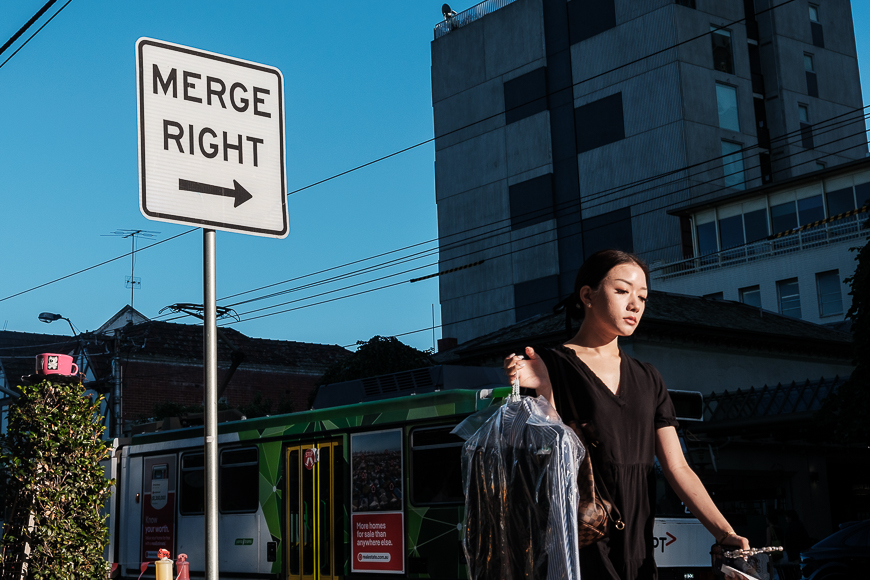
A big part of seeking light is being aware of where the light is falling and why. Especially at golden hour, the contrast can be very striking with a persons face lit while the background is in deep shadow. It’s a dramatic look that I love to capture. However, I need to know what side of the person, foot patch, and street I need to be on to make the shot work. There’s no point me standing where the subjects face is in shadow – especially if I want them as a key feature. Knowing where the sun is located is a mindfulness that I find necessary. Furthermore, knowing where the sun rises and where its arc will travel across the sky can be a huge help in planning compositions of any genre.

At each end of the day, especially during golden hour, the sun will cast long shadows that move fairly quickly as the sun rises or sets. Understanding where the shadows will move can help to build a brilliant composition. If you’re working in a local neighbourhood or big city, know the lay of the land and how the light moves throughout the day. Big cities are great for this as they trap light in all sorts of amazing ways thanks to the canyon like rows of building, grid layout, and the reflected light from tall buildings.
Composition
As mentioned, understanding where the light will fall is a key element to how I build a composition. However, it’s not the only element to consider – especially when it comes to street photography. Street work is fast paced and ever-changing. It’s one of the elements that attracts me to it. Life is fleeting and it’s more evident than ever on the streets where people rush about their world. I aim to capture unique moments in time and space that will never be available again with the same compositional elements. The subject will rush on. The sun will move. Or a big truck will pull up and block your view. It all changes, all the time!

Recently, I’ve been trying to build upon my street photography composition skills. I have a good mate, John, who is an exceptional street photographer. Further to this, he’s a master at composition and building a narrative with both subject and surrounds. It’s uncanny just how he achieves this. He has inspired me to be more conscious of background, foreground, and subject in how I build a composition. Having a great subject is one thing. Placing them in an environment that emphasizes the narrative is a whole next level operation. As a result, I’m constantly scanning my environment looking for a stage through which a subject may pass. I look out for street signs, shop signs, reflections, displays in shop windows, street lights, traffic lights, and colours. In my local area of South Yarra, a lot of the light posts are painted deep red – they make for great anchors in a composition. Street art is another great addition to street photography composition and there’s plenty of that around here.
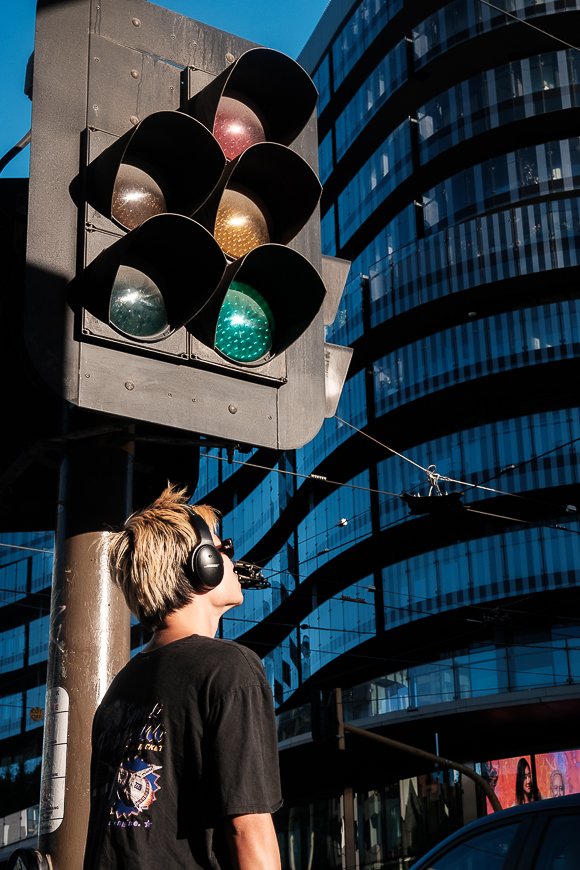
Primary colours are also great draw cards in street photography compositions. It can include the environment and the subject. For example, a scene that’s mostly dull grey concrete and black roads will pop if there’s a red post box and a person walking past it in a bright yellow top. Add to this a deep blue sky in the background and you have a pretty good composition. It takes a lot of practice and patience to find, see, and make the most of compositions in street photography. I always look for interesting combinations of elements to create an interesting scene.

Setting Up A Light Trap
I mentioned earlier that street photography is a fast moving game. It’s a fast moving process for the photography too. Most times, I’m on the move seeking out the next composition or shot. I don’t chase people or run ahead of them to get the shot ready – if I’m not in the right spot at the right time, then that’s my loss. Running ahead or drawing attention to myself changes the value of the process. It’s not natural and the subjects around you become wary. From time to time, I’ll find a great composition where the light is falling just right and the environmental elements are perfect. In these situations, I will find my position and wait patiently for the right subject to walk into or out of the light. I need to be relaxed and discreet so as not to impact the authenticity of the moment. Often I’ll lean against a pole or wall and hold my camera at waist height.

Both the Fujifilm X70 and the Fujifilm X-E4 have rear flip-up screens. I will peer down at the screen to ensure I have the composition in frame and wait for the subject to make their move. It’s not a foolproof process as sometimes you can wait and watch however the right subject won’t take the path you’d hoped. And that’s ok – the moment passes and I move on. At other times, I will be walking down the street and the right composition will suddenly appear with an ideal subject. There’s barely a moment to lift my camera and take the shot. This is why I’m constantly adjusting my exposure settings as I move along. If I’m on the sunny side of the street, I’ll increase shutter speed and drop the ISO. If I’m on the shaded side of the street, I’ll drop the shutter speed and bump the ISO up a little. What’s more, my camera is always in my hand with a wrist strap to keep it safe. When I see the shot, I lift the camera, frame the shot, and press the shutter. No wasted time setting shutter speed, aperture, or ISO. It’s simply point and shoot!

Being Present
Probably the biggest element of street photography is being present in the moment. My methodology builds upon the core idea that street photography is about capturing a moment in time that is unique and appealing. It’s to document the way in which complex humans move through a complex and busy world. If you’re not present enough, you can’t possibly capture the shots. When it comes to being present, there’s two separate definitions. The first is actually being there at the time when the composition existed. Being out and about with a camera is the number one step to achieving this. Having a camera in my hand at all times allows me to capture almost all of the shots I wish to take. No point having a camera in a bag or backpack if you miss the shot. Making regular time to get out and shoot is essential to skill development and experience. We learn just as much from the shots that work as we do from those that don’t. With this in mind, I try to get out every second day – even if it’s just a short walk down to my local train station.

The second definition of being present is the mindfulness type. It’s one of the main reasons I prefer to be on my own when I shoot street photography. Being distracted is a sure fire way to not only miss a shot, but to also lose the groove. I’m not always in the mood for street photography – sometimes my mind is busy and I just can’t see the compositions. I’m also a complex human moving through a busy world. I will still go out for the walk and attempt to take photos – I may come home with a bunch of duds but I will learn from them regardless. I also tend to have headphones on while I walk – listening to the right playlist helps to build the groove and achieve mindfulness.
Final Thoughts
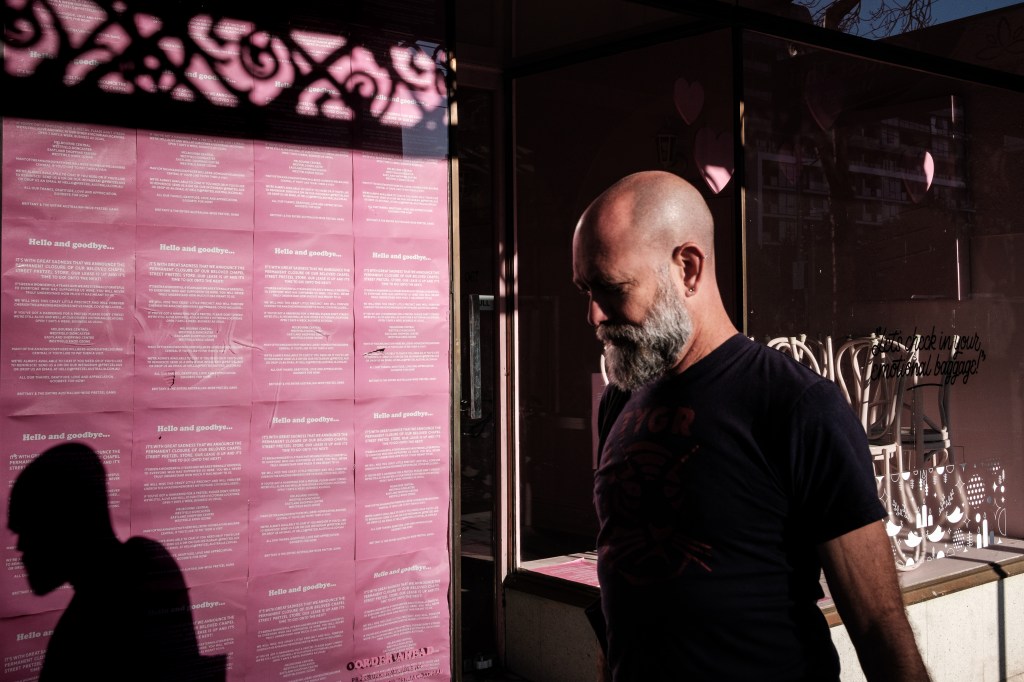
At the end of the day, every photographer has a different approach to how they hunt light, build compositions, and capture the shot. I believe that being mindful of my approach has helped me understand how I work and how I do what I do. The more I get out with my camera, the more my creative brain awakens. The more present I am the more likely I am to see that brief moment in time where the light is right, the subject arrives and I take the shot. It gets to a point where I can see it unfolding before I’ve even started to lift my camera. I’ve also notice, that on the rare occasions where I am out without my camera, I’m constantly scanning the scene and building compositions. It’s times like these that I berate myself for not bringing my camera with me.

I want to also take a moment to thank my friends and the members of the various photography communities I’m a part of. I’ve received so much positive praise, support and encouragement over the past few weeks. It’s been amazing and makes me proud to have gotten through the past two years and returned to this artform once again. Thanks guys. Happy shooting. G
 Greg Cromie Photography
5 Responses to Rediscovering The Light – Hunting Light
These are beautiful images Greg. I commend you on your ability to stay put and wait for the shot….I get itchy feet and have to keep moving.
Love your work mate.
LikeLike
I can’t linger too long or they’ll bust me for loitering! Lol
LikeLike
hi dad its me brendon i liked the article you wrote very inspiring
LikeLike
[…] my love of all things photography. For those of you that have been reading along, in my last entry, Rediscovering The Light – Hunting Light, I discussed my process for following the fall of light and shadow throughout the day. I’ve […]
LikeLike
[…] Rediscovering The Light – Hunting Light, I talk about my approach to street photography, working with the available light, creating […]
LikeLike