
Hello, and welcome back to my photography/travel/life blog. My blog is very photography-focused (pardon the pun), and my life is very photography-focused. I’ve been busy with many different projects in recent weeks and have also had a week or so off sick with Covid. It’s my third time catching the plague and, touch wood, it was the least impactful of the trio. Covid One was probably the Omicron variant, but it came at a time when Melbourne’s testing was out of control. Cars would queue for hours outside testing centres before being waved through to roll down their windows and have a person in PPE shove a swab up their nose. So, while we were tested, we never received confirmation of our results as the testing labs announced they were overrun and couldn’t get to them all. Massive public health failure. Covid Two was the worst of the bunch and occurred in late 2023. It was the sickest The Doctor and I have ever been in our lives. Covid Three has been the mildest and more like a nasty flu, but the headache is the worst part. I’m on the mend and have taken the necessary time to keep isolated – not that social rules call for that so much anymore.
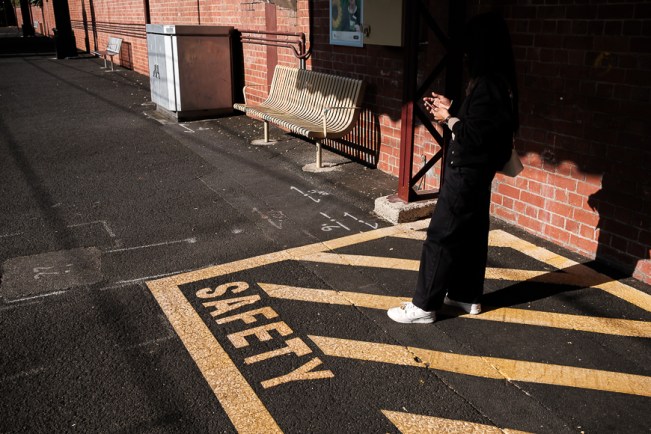
I headed into Melbourne CBD yesterday to get some fresh air, stretch my legs, and spend some time hunting the light with my camera. I packed fairly light as I only took my Fujifilm X-E4 with the Fujifilm XF 23mm F2 lens. It’s such a perfect combo – lightweight, compact, discreet. I recently spent a couple of weeks shooting with the Fujifilm X-T5. I’ve owned past generations of the Fujifilm X-T family, including the X-T1, X-T2, and X-T3. I also tested and reviewed the Fujifilm X-T4 when it was launched. The Fujifilm X-T5 is an absolute beast of a camera, and it’s clear why it’s Fujifilm’s flagship photography model. They boosted the X-T5 with a new X Processor 5 and a 40.2MP X Trans 5 image sensor. While retaining the same form and retro-inspired design as the first generation, the X-T5 also has a stunningly bright and big EVF and a high-resolution LCD. I will cover my work with that camera in another blog – I also have a review on Shotkit that will be published in the coming weeks.
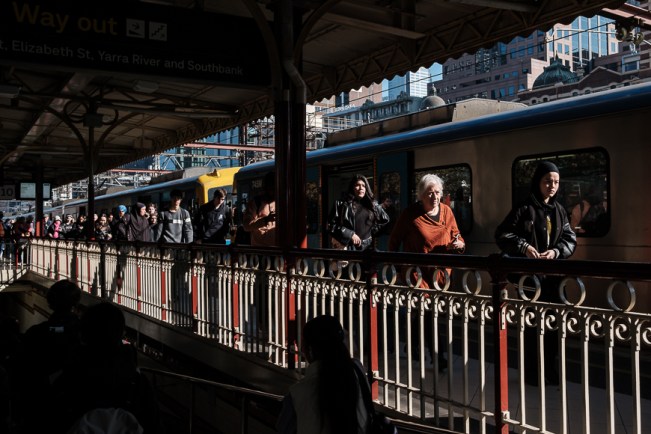

Back to my street walk. I caught the train from Hawksburn Station – a five-minute walk from home – and got off at Flinders Street Station. It was around 10am, and the day was a fine 17 degrees with blue skies and a smattering of clouds. The autumn light has been fantastic recently, with the golden hues lasting till late morning and starting again mid-afternoon. I wanted to make the most of that light so I got most of my writing work finished early. I wasn’t on the hunt for anything specific – just people interacting with their world. Given the excellent light quality and the sun’s low arc, lots of long shadows flooded the city streets and canyons – building-canyons. I exited Flinders Street Station at the Elizabeth Street underpass and took my time walking up Flinders Street towards Swanston Street and Federation Square.
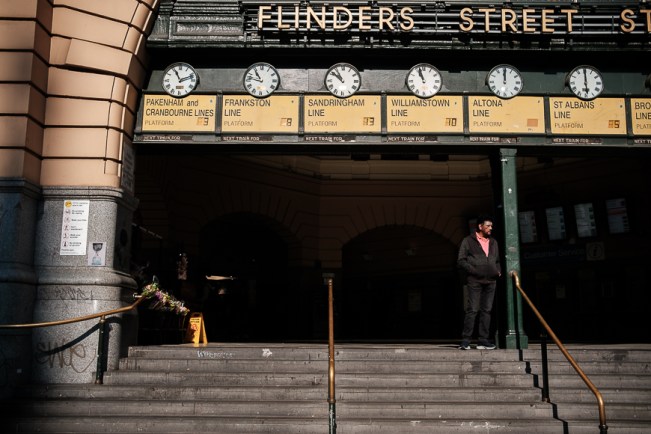
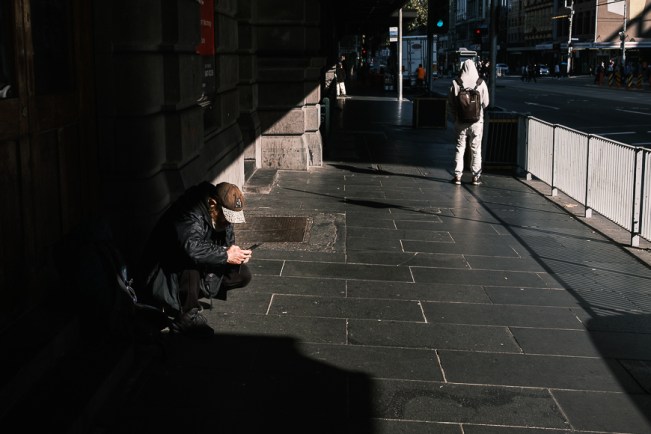
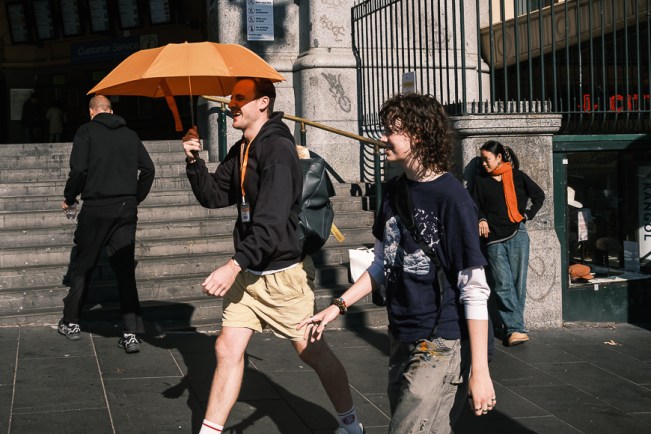
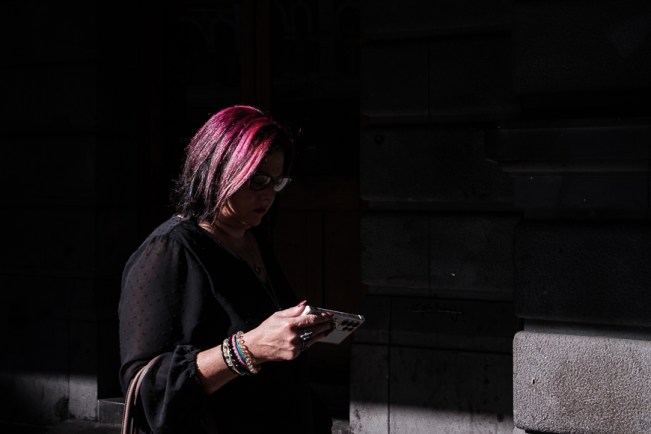
Given the time of day, there was still plenty of foot traffic around the station without it being overwhelming or crowded. At times, the footpaths and shop fronts were vacant. At other times, there were just enough people to make the street scenes more interesting and add context to a composition. I wasn’t in a hurry and sometimes hung around an area to make the most of the dynamic shadows and light shafts falling across the scene. I go into more detail about this process in my Hunting Light blog from a few weeks ago. Light straps allow me to stop for a few minutes and watch people step in and out of the shadow into a strongly contrasted shaft of light. It’s a method mastered by my friend John St, who is one of my inspirations for street photography. He has this uncanny knack for capturing the most dynamic light-trap-style street scenes I have ever seen.

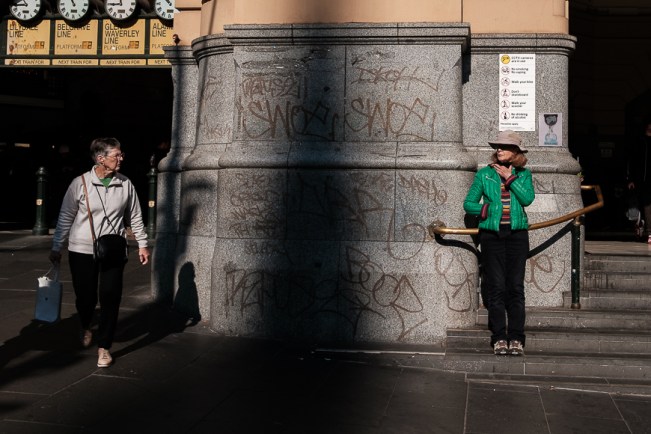
At the main entrance to Flinders Street Station, at the corner of Flinders and Swanston, I hung around for a bit and watched the ebb and flow of people moving about the station. Given the strong contrasting light, the station entrances were deep in shadow, and people would suddenly appear out of the gloom and into the light. I wandered around that area for a while to make the most of the light and the interesting people that moved through the space. Street photography isn’t an exact science; sometimes, the shots work out, and others don’t. If they didn’t work, then that’s fine, and I move on. Street scenes are in constant flux as each individual is guided by inner machinations to move through the world to their intended or unintended destinations. I might see someone on course to enter a composition that would make for a winning shot. But their path is interrupted and diverted by some seen or unseen element, and the opportunity disappears. Street photography is all about being present and in the moment.
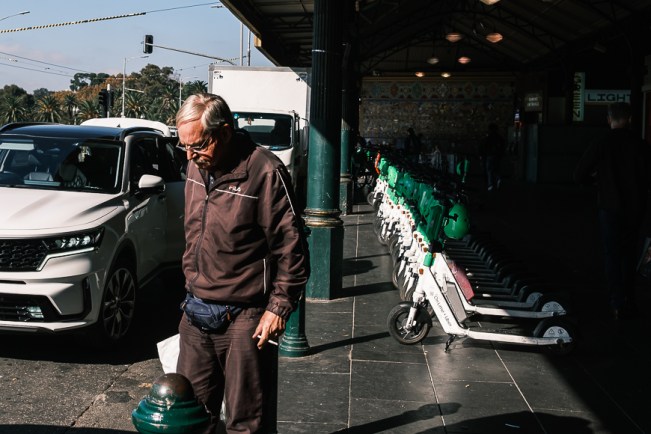
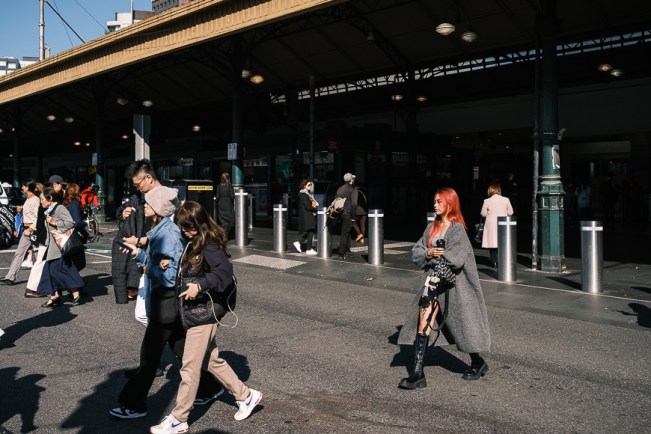
From the corner of Flinders and Swanston, I made my way South towards the Art Centre but didn’t pass the bridge that crossed the Yarra River. I found myself turning around, heading north and then retracing my steps back towards Elizabeth Street. That gorgeous light was still working its magic and was hard to move away from. I made my way north up Elizabeth Street, stopping here and there as light fell across the scene between the buildings. By this time, Bourke Street was in complete shadow except for the reflected light from the tall office buildings diagonally across from the old General Post Office. The light is dappled and softened by the vast, glazed windows of the office building. As a result, the light falls in soft blobs rather than shafts.
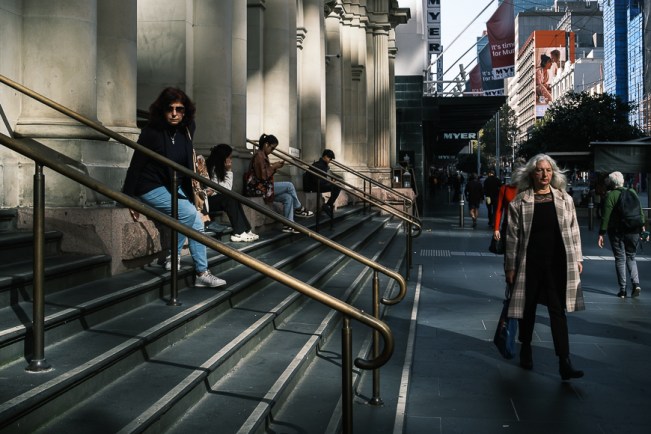
Satisfied with my morning’s efforts and given I was still a little tired from having the plague, I decided it was time to head home. But not before I stopped by a couple of the camera stores on Elizabeth Street. I have my eye on a couple of items at the moment. One is a longer prime lens, and the second is a new iMac for my work. Neither is cheap, and both can wait. While testing the Fujifilm X-T5, I also tested the newer Fujifilm XF 56mm F1.2 WR lens. It was released in 2022 and is a rebuild of the 2012 Fujifilm XF 56mm F1.2 portrait lens. The new model delivers superior image quality and vastly improved autofocus performance. Stay tuned for my Shotkit review. The new XF 56mm was loaned from Fujifilm Australia, so I had to send it back. It would cost around $1700 AUD for me to buy one, and I just cannot justify the cost at the moment. However, I want the smaller, lighter, and cheaper Fujifilm XF 50mm F2 lens. I’ve owned this lens before but sold it when I became unwell and needed the cash. I regret selling it and would like to return it to my kit for portraits and product shots. I take more product shots now that I am writing for Shotkit again, and it makes good business sense to have a suitable lens.

As for the iMac, I mentioned in my last blog – My Current Lightroom Workflow – that my 2017 iMac is running slow. This is especially evident when using Lightroom and editing files. The files from the Fujifilm X-T5 and X100 VI are created by 40 MP image sensors, and the files are much larger than those of my X70 or X-E4. While editing those larger files, Lightroom would take 5-7 seconds to load each image, and sometimes the Develop tab wouldn’t even load the image – just a black screen. So, it’s time to consider upgrading. I like the look of the new M3 chip iMac models, but they are pricey, and I don’t have that kind of cash or income just yet. It’s not mission-critical, but it is definitely time to upgrade and future-proof for the sake of my business. So those two items are on my radar, along with a bunch of household upgrades, and of course, The Doctor and I are expected to feed the children! More on those two endeavours coming soon – the lens and computer that is. I hope you’ve enjoyed this little story of a day spent out and about with my camera. If you’re looking for photography inspiration, my advice is to just take a walk. Get out with your camera always in your hand and look for the light. Happy shooting. G

 Greg Cromie Photography
Leave a comment